History, in its most popular form, is often reduced to a series of dry dates, simplified battles, and romanticized figures. The story of Saladin Eyyubi (Selahaddin Eyyubi) is perhaps one of the greatest victims of this simplification. In the modern consciousness, he is frequently depicted either as a generic, idealized medieval hero or trapped within modern, sterile ethnic debates over whether he was “Arab or Kurdish.”
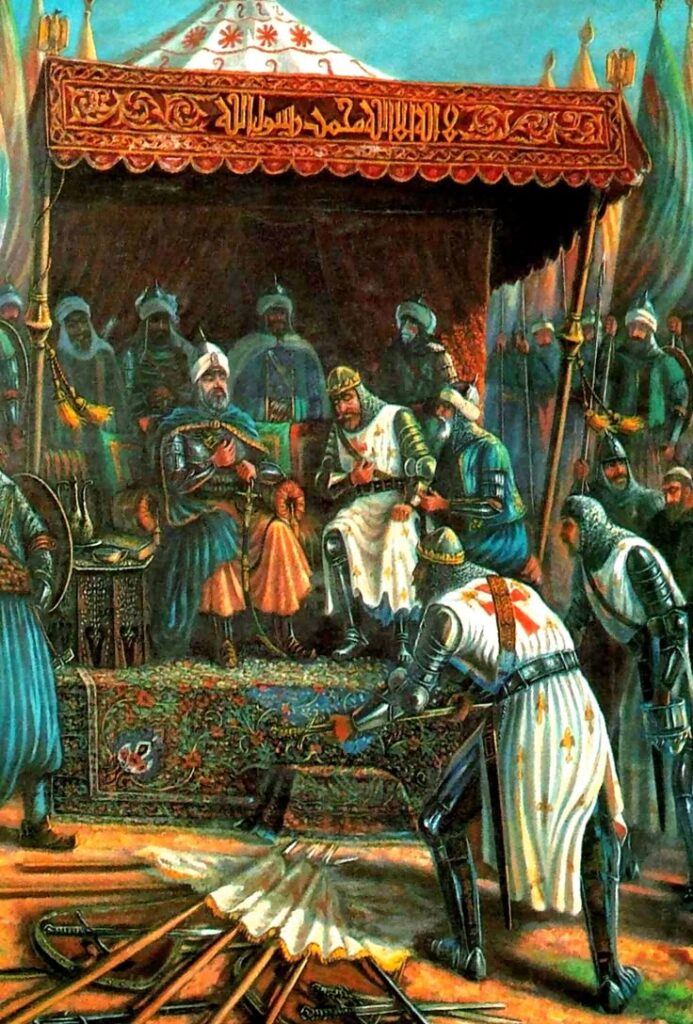
However, the real historical record, as explored through deep geopolitical analysis, reveals a story that is far more complex, structured, and tragic. To understand Saladin is to understand a masterclass in statecraft, tactical genius, the weaponization of virtue, and a profound, late-stage realization of a shadow war fought against an invisible, transnational adversary.
I. The Spirit of the State: The Ayyubid Identity Codes
To understand the leader, one must first understand the machine he commanded. The Ayyubid State was not a historical accident or a loose tribal coalition; it was the continuation of an unbroken, highly structured Turkic military-administrative tradition. Rooted in the statecraft of the Zengids, this state apparatus would eventually evolve into the Mamluk Sultanate.
While modern discussions focus heavily on ethnic labels, the structural reality of the Ayyubid state was uncompromisingly Turkic—arguably even more homogeneous and strict than the later, cosmopolitan Ottoman Empire.
The most undeniable proof of this identity lies in the state’s linguistic and administrative hierarchy:
- The Command of Language: While the Great Seljuks utilized Persian in their bureaucracy, the Ayyubids operated entirely in Turkish. In a territory stretching across Egypt, Syria, Yemen, and the Hejaz—where the local population was overwhelmingly Arabic-speaking—the language of the court, the elite, and military command remained Turkish.
- The Steel Core of the Elite: The Ayyubid military and administrative apparatus maintained an exclusive, liyakat-based structure. Only Turks were appointed to critical governorships and military commands. Trust was established through this shared kinship, forming a tightly-knit military aristocracy. This is reflected in Saladin’s closest inner circle: his brothers Turanshah, Tughtekin, and Al-Adil, alongside elite commanders like Gökböri.
This stark, disciplined reality did not escape contemporary observers. Arab chroniclers of the era openly declared, “God has exalted Islam by the hands of the Turks,” recognizing that only the swords of this Turkic elite stood between the Islamic world and total Crusader annihilation. In the West, the sheer physical and tactical dominance of these forces birthed the famous European idiom, “strong as a Turk” (Fort comme un Turc).
II. Hattin: The Masterclass of Tactical Annihilation
If the Ayyubid state was the weapon, the Battle of Hattin in 1187 was its most flawless execution. Saladin’s ultimate objective of liberating Jerusalem required him to draw the Crusader forces out of their heavily fortified coastal castles—to “lure the snake out of its hole.”
He achieved this by exploiting the arrogance of Raynald of Châtillon, who broke a standing truce by plundering a wealthy Muslim caravan. With a legitimate casus belli in hand, Saladin mobilized his forces, setting a trap that would utilize geography, climate, and psychology as active combatants.
In the blistering July heat of Palestine, the Crusader army of 23,000 marched toward the water sources of Galilee. Saladin, commanding nearly 30,000 men, did not engage them in a standard pitched battle. Instead, he deployed his archers on strategic ridges, launching continuous, harassing hit-and-run attacks. This relentless pressure slowed the heavily armored Crusaders to a crawl, turning a projected four-hour march into a multi-day ordeal.
Parched and exhausted, the Crusaders took refuge on the dry hill known as the Horns of Hattin. On the morning of the battle, Saladin ordered his forces to set fire to the dry grass surrounding the hill. Trapped in a choking abyss of smoke, ash, and flame, the Crusader ranks completely fractured.
The Ayyubid cavalry charged through the dummey and smoke, converting the battle into a systematic annihilation. The Crusaders’ ultimate spiritual relic, the True Cross, fell into Ayyubid hands, and their military presence in the Levant was effectively shattered.
III. The Politics of Virtue and Chivalry
The aftermath of Hattin showcased the defining trait that elevated Saladin above his contemporaries: his calculated, moral pragmatism. In an era when military victory was almost universally written in the blood of slaughtered civilians—such as the horrific Crusader sack of Jerusalem in 1099—Saladin chose the path of extraordinary mercy.
When Jerusalem surrendered in 1187, Saladin rejected the urge for vengeance. He established a highly organized ransom system, but more importantly, he personally funded the release of thousands of destitute widows, orphans, and elderly who could not afford their freedom. He returned the keys of the Holy Sepulchre to the Orthodox Christians and invited the exiled Jewish community back to resettle the city, restoring a fragile ecosystem of coexistence.
This leniency drew sharp criticism from his own emirs, who argued that “excessive mercy to the enemy is treason to the state.” They feared that releasing battle-hardened knights would only fuel future crusades.
Yet, Saladin’s vision was far more sophisticated. He understood that he was fighting a war of ideas. By acting with absolute chivalry, he stripped the Crusader movement of its moral authority. His character became so legendary that even his fiercest Western enemies chronicled him as the “mirror of virtue,” establishing a legacy of moral dominance that outlived his physical empire.
IV. Behind the Veil: The Realization of the Shadow War
The twilight of Saladin’s reign was marked by the Third Crusade and his legendary duel with King Richard the Lionheart. While popular history focuses on their battlefield clashes, the true climax of their conflict was diplomatic and intellectual.
Richard, recognizing the strategic impossibility of holding Jerusalem, initiated a series of radical, almost desperate peace proposals—including a bizarre suggestion to marry his sister, Joan of Sicily, to Saladin’s brother, Al-Adil, to rule Jerusalem as a joint Christian-Muslim protectorate. Though the plan ultimately collapsed due to religious opposition, it revealed the deep levels of political satranç played by both sides.
More importantly, during these diplomatic exchanges, Richard delivered a chilling, cryptic revelation to Saladin’s envoys. He warned the Sultan that he was not merely fighting mortal kings. The true driving force behind the Crusades was the transnational, sovereign deep state of the Knights Templar.
The Templars operated as the world’s first global banking system. They held vast estates across Europe, controlled the Mediterranean shipping lanes, and possessed liquid capital so immense they could purchase entire nations—such as Cyprus, which they bought directly from Richard. They did not answer to kings, only to their own shadow hierarchy.
Saladin, who had already implemented a policy of executing captured Templar knights due to their fanatical refusal to be ransomed, began to realize the terrifying truth: he was fighting an immortal, financial-military system. He could shatter their armies on the field of Hattin, but the financial core of the Temple in Europe remained entirely out of his reach.
V. The Solitary Eagle’s Fall and Legacy
This profound realization cast a heavy, melankolik shadow over Saladin’s final days in Damascus. He saw that the vast Islamic unity he had forged was held together solely by the thread of his personal charisma.
On March 4, 1193, the great Sultan passed away at the age of 55. When his treasury was opened, it was discovered that the master of the Middle East died penniless. He possessed only one gold dinar and 47 silver dirhams, having given his entire wealth away to charity, his soldiers, and the defense of his lands.
The tragedy of his death was the immediate, rapid decay of his empire. His successor sons, lacking his moral stature and political intellect, proved to be weak, incompetent rulers (alik). Within decades, the Ayyubid domains fractured under the weight of internal greed and systematic Crusader offensives targeting Egypt. This decline ultimately culminated in the Mamluk Coup of 1250, where the elite Turkic slave-soldiers seized power, and the remnants of the Ayyubid royal lineage were hunted down and hung from the gallows.
The physical empire of Saladin was erased from the map. Yet, his legacy remains untouched by time. He stands as the “Red Eagle” of the desert—a solitary, powerful force who proved that while empires of stone and steel eventually crumble, an empire built on character, virtue, and uncompromising honor is immortal.
That’s awasome