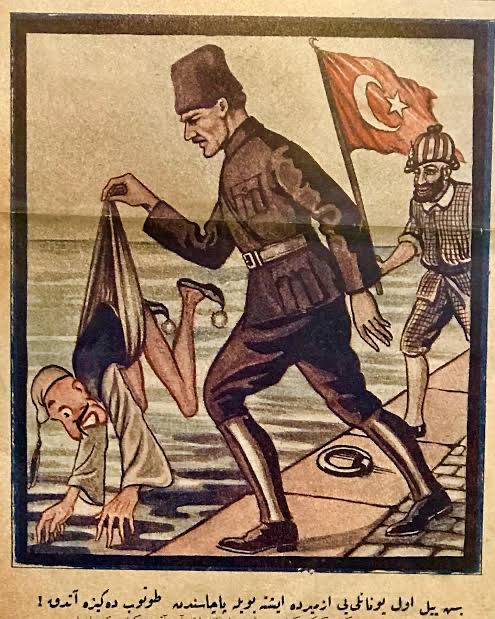
With the foreign occupying forces formally evacuating the old imperial capital following successful international peace negotiations, the new national leadership turned its focus entirely inward. The external war was won, but the internal battle for total, unquestioned domestic control had just begun. This era witnessed the systematic dismantling of civil liberties, the silencing of the press, and the ruthless eradication of all political opposition.
The Foundation of the Single-Party Regime
In the autumn of 1923, the leader of the national resistance formally announced the creation of the “People’s Party,” which rapidly became the sole political entity in the country. The party was established upon a foundational manifesto that clearly outlined the regime’s socio-economic priorities.
The manifesto adopted a decidedly capitalist and elitist approach. It explicitly aimed to support and enrich landowners, merchants, and industrialists to cultivate a loyal national bourgeoisie that would eliminate the state’s reliance on foreign capital. Conversely, the working class was marginalized, and the manifesto openly stated that no special efforts would be made to support the intellectual class, whose only expected role was to enlighten the public in accordance with the state’s ideology.
Upon winning the orchestrated elections of 1923, the leader assumed the presidency of the newly declared republic and handed the leadership of the People’s Party and the prime ministry to his most loyal military subordinate. This move permanently intertwined the mechanisms of the state with the apparatus of the ruling party.
The 1925 Rebellion and the Law on the Maintenance of Order
The transition to a single-party republic faced immediate domestic resistance. A culture of severe censorship was swiftly implemented. The regime issued stark warnings to the press, declaring that any journalists who dared to publish content critical of the government or the ruling party would be subjected to the dreaded Independence Courts.
The perfect pretext to institutionalize this autocracy arrived in 1925 when a massive, religiously motivated rebellion erupted in the eastern provinces. Rebel forces captured several towns and besieged major eastern cities. In response, the ruling government forced the resignation of its moderate prime minister, replacing him with a hardliner who immediately passed the “Law on the Maintenance of Order.”
This draconian legislation granted the government extraordinary emergency powers for two years. The Independence Courts were immediately resurrected—one operating in the capital and another in the rebellious eastern provinces. While the eastern tribunal oversaw the mass executions of the rebel leaders and their sympathizers, the government utilized the emergency law to launch a nationwide crackdown on civil society. Every single opposition newspaper, independent magazine, and critical publication was permanently shut down. Journalists were arrested en masse, leaving the state with an absolute monopoly on information.
The Assassination Plot and the Great Purge
In the summer of 1926, the regime uncovered a plot to assassinate the president during his visit to a western coastal city. The conspiracy involved a small group of disgruntled politicians and hired gunmen. The president, having been tipped off, delayed his arrival, and the conspirators were swiftly arrested.
However, the regime immediately weaponized this failed plot, transforming a localized conspiracy into an opportunity for a massive, sweeping political purge. Under the guise of national security, the government ordered the arrest of over a hundred individuals, the vast majority of whom had absolutely no connection to the assassination attempt.
The dragnet captured the nation’s most prominent opposition figures. This included the most revered commanding generals of the war of independence who had politically opposed the president, as well as the surviving intellectual heavyweights and former cabinet ministers of the old revolutionary committee that had ruled the empire a decade prior.
The Show Trials and the Eradication of Rivals
The arrested politicians and generals were dragged before the Independence Court in the capital. The proceedings quickly revealed the true nature of the tribunals. During the interrogations, the chief prosecutor barely mentioned the assassination attempt. Instead, the defendants were aggressively questioned about political decisions they had made up to twenty years earlier, such as their roles in entering the Great War or their ideological differences with the president during the founding of the republic.
Despite the glaring lack of evidence connecting the political rivals to the actual assassination plot, the court’s verdict was predetermined. Fifteen prominent political figures—including six active members of parliament and a former finance minister—were sentenced to death. They were hanged in the dead of night, mere hours after the sentences were handed down, while one committed suicide before reaching the gallows.
A handful of the most famous military commanders were spared execution through a calculated, last-minute presidential pardon, a move designed to display the president’s ultimate authority over life and death. The message, however, was unmistakable: the political opposition had been physically and psychologically annihilated. By the end of 1926, there was no one left in the country with the power, influence, or courage to challenge the supreme leader.