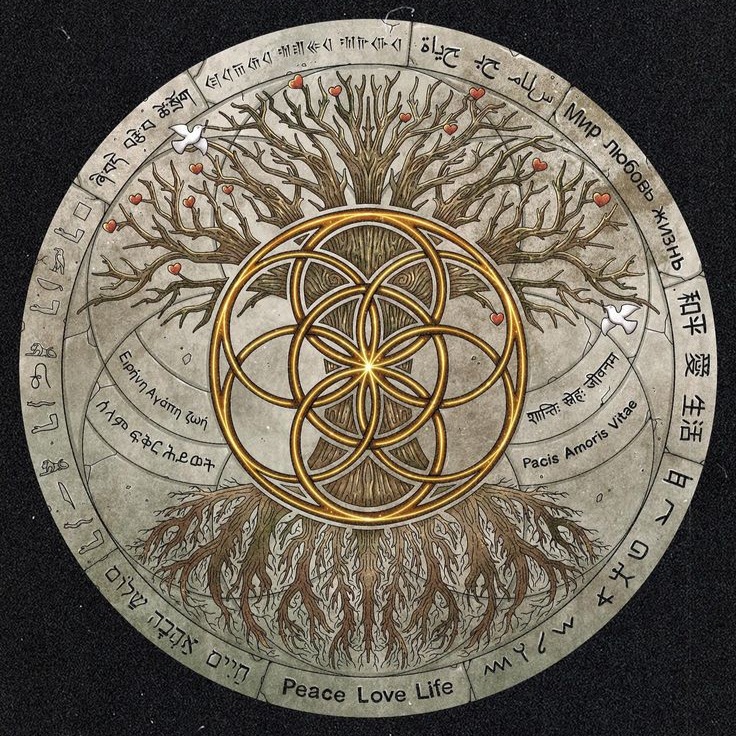
Magic and sorcery are frequently dismissed in modern discourse as primitive superstition or cinematic fantasy. However, a rigorous historical, sociological, and anthropological examination reveals that metaphysical systems have operated as an enduring component of human civilization since the Paleolithic era. Long before the codification of monotheistic religions, human societies interacted with unseen forces through structured, technical frameworks. When paired with high-level esoteric frameworks such as Kabbalah—the mystical tradition of Jewish esotericism—these systems present a comprehensive, multi-layered blueprint of reality, consciousness, and cosmic mechanics.
Part 1: The Epistemological Divergence: Magic, Religion, and Science
To understand the mechanics of sorcery and esoteric philosophy, one must distinguish them sharply from both institutionalized religion and modern materialism. Although religion and magic both deal with the metaphysical, their social structures and operational logics are fundamentally opposed.
The Communal Nature of Religion versus the Individualism of Magic
- Religion as a Mass Institution: Religion is inherently communal, uniting clans, tribes, or states under a standardized moral and hierarchical framework. It demands absolute obedience, submission to divine authority, and the surrender of individual autonomy, relying on faith and the promise of an afterlife.
- Magic as an Individualized Craft: Magic is specialized, individualized, and inherently secretive. It is never practiced to unite mass congregations; rather, it operates through direct, clandestine transmission—commonly known as master-apprentice lineage transfer. In magical traditions, a master passes their metaphysical capability and internal knowledge directly to a chosen successor.
The Instrumental Function of Magic
Religion is its own purpose; individuals adhere to religious frameworks out of existential obligation, obedience to divine law, and salvation metrics. Magic and esoteric systems, by contrast, are strictly instrumental. They are never performed as passive rituals of worship; they are active, technical tools deployed to achieve an immediate, tangible outcome in the material world.
The Alignment with Empirical Science
Anthropologists such as Bronislaw Malinowski and James Frazer have demonstrated that magic shares profound structural similarities with empirical science. Both systems operate within the boundaries of the natural world rather than relying on supernatural violations of physical laws.
- Cause-and-Effect Mechanics: Magic utilizes terrestrial materials, biological elements, and environmental conditions. Like science, it operates on trial and error. If a procedural application fails to produce the desired result, the practitioner modifies the components and variables until operational success is achieved.
- The Problem of Absolutism: While religion claims absolute, immutable truths anchored in sacred texts, both magic and science accept operational error, systemic failure, and the need for iterative correction.
Part 2: Ancient Epicenters of Sorcery and Metaphysical Traditions
Throughout antiquity, specific geographical regions established themselves as epicenters of esoteric knowledge, embedding operative metaphysics into statecraft and philosophy.
- Mesopotamia and Astral Sorcery: The Chaldeans of Babylon integrated astrology with operative magic, mapping societal phenomena, plagues, and individual fates directly to planetary movements such as Saturn (death and decay), Mars (conflict), and Jupiter/Venus (governance and social order). Monarchs summoned Chaldean specialists to decode complex dreams and retrieve lost empirical data.
- Classical Antiquity and Medical Schisms: In Greece, divine figures like Hecate and Medea personified binding rites and nocturnal sorcery. While early physicians like Hippocrates attempted to separate medicine from metaphysical affliction (such as reframing epilepsy as a physiological disorder), legal codes persistently criminalized harmful sorcery.
- Persian Dualism and Vedic India: Zoroastrianism established a strict dual cosmology dividing existence between cosmic good and evil. In India, Vedic traditions integrated ritual sacrifices and magical formulas, sparking political and social rivalries between orthodox priests and independent occult practitioners who controlled agricultural fertility and health.
- Arabian Esotericism and Abrahamic Prohibitions: Pre-Islamic Arabian society advanced numerical grids and geometric matrices to craft protective talismans. Across all Abrahamic texts (Torah, Gospels, Quran), sorcery is universally condemned as an existential threat to divine sovereignty—an unauthorized attempt to manipulate reality, driving operative magic permanently underground.
- Turkic and Shamanic Cosmologies: Inner Asian nomadic societies utilized spiritual specialists known as Kam or Shaman to manage tribal protection and atmospheric forces. Practices like lead-pouring (kurşun dökme) evolved as psychospiritual healing mechanisms to neutralize environmental intrusions (yel).
Part 3: Empirical Case Studies in Practical Sorcery
Field research and academic literature document documented instances where metaphysical practices intersected with real-world human behavior, illustrating the devastating efficacy of interpersonal malice channeled through operative sorcery.
Case 1: The Wedding Ring and the Broken Union
In a documented Central Anatolian case, a paternal aunt opposed her nephew’s impending marriage. Days before the wedding, she acquired the groom’s ring, coated it with specialized organic catalysts, performed a binding ritual, and buried a corresponding talisman in a distant cemetery.
On their wedding night, despite months of genuine affection, the groom perceived his bride as a monstrous serpent. Overwhelmed by visceral terror, he rejected her instantly, leading to an immediate legal divorce. Anthropological follow-ups confirmed that the psychological aversion persisted permanently, rendering reconciliation impossible due to the unrecovered cemetery artifact.
Case 2: The Wasting Death Spell
In another documented case, after a young woman rejected a man’s romantic advances, the man’s mother sought out a sorcerer to execute a lethal death spell. Despite initial skepticism, the young woman’s health deteriorated rapidly without organic cause. Comprehensive medical evaluations revealed no tumors, infections, or identifiable pathologies, yet her immune system systematically collapsed until death occurred under clinical observation—highlighting the profound physiological impact of severe psychological conditioning combined with targeted metaphysical manipulation.
Part 4: The Origins and Historical Evolution of Kabbalah
Transitioning from general anthropological sorcery to structured esoteric philosophy, Kabbalah represents the zenith of Jewish mysticism.
- Etymology: The term derives from the Hebrew root Q-B-L, meaning “to receive, to accept, or to take divine revelation.”
- Historical Origins: While traditionalists claim the doctrine was delivered directly to Adam and possesses no historical beginning, alternative historical frameworks anchor its emergence in Antik Mısır (Ancient Egypt), Assyria, and crucially, Pythagorean philosophy. The emphasis on numbers, geometry, and the cosmic scale aligns heavily with Pythagorean models.
- Oral Tradition and Lineage: Kabbalah is not a dogmatic religion, but an esoteric discipline. It relies strictly on master-apprentice transmission (ustalık-çıraklık ilişkisi). Public mass preaching is absent; knowledge is transmitted privately through rigorous spiritual discipline, asceticism, and the mastery of Hebrew as an operational linguistic matrix.
Part 5: Torah, Gematria, and Batim Hermeneutics
In Kabbalistic philosophy, sacred texts are not read merely for historical narrative or moral instruction.
- Zahir and Batin: The literal, exoteric text of the Torah (Zahir) is designed for the uninitiated masses. The esoteric, hidden layer (Batin) contains the true cosmic blueprint encrypted through numerical matrices and linguistic ciphers.
- Gematria and Numerical Codes: Hebrew letters double as numerical values. By calculating the digital sum of specific words and verses (Gematria), Kabbalists uncover hidden correspondences, historical timelines, and cosmological prophecies. For instance, historical movements and messianic expectations—such as the emergence of Sabbatai Zevi in 1648—were calculated using precise alphanumeric transformations derived from scriptural texts.
Part 6: Kosmoloji and the Sefirot (The Tree of Life)
Kabbalistic cosmology is radically monistic and emanationist. Everything in existence originates from a singular, unified source.
- Ein Sof (The Infinite Nothingness): The ultimate Creator is defined as Ein Sof—absolute, transcendent, and beyond all human definition or categorization. It is referred to as Ain (Nothingness) not because it does not exist, but because it exceeds all human intellectual parameters.
- The Ten Sefirot: To manifest reality, Ein Sof projects itself through ten divine emanations known as the Sefirot (derived from the Hebrew word for numbers). These ten principles form the cosmic Tree of Life:
- Keter (Crown): The primordial will, absolute transcendence, and first cause.
- Hokhmah (Wisdom): The active, intellectual spark (the cosmic “Father”).
- Binah (Understanding): The receptive, structural matrix (the cosmic “Mother”).
- Chesed (Mercy): Unconditional expansion and divine love.
- Gevurah (Judgment/Severity): Restriction, boundary, and cosmic law.
- Tiferet (Beauty/Harmony): The central balancing point, associated with prophetic equilibrium.
- Netzach (Eternity): Endurance and persistence.
- Hod (Splendor): Reverberation, chemical form, and physiological structure.
- Yesod (Foundation): The subconscious matrix, generative energy, and psychological core.
- Malkuth (Kingdom): The physical, material world (Asiyah), representing the absolute condensation of divine light into matter.
Part 7: Lurianic Kabbalah: Zimzum, Shevirat ha-Kelim, and Tikkun
In the 16th century, the mystic Isaac Luria (Luria ha-Kadosh) revolutionized Kabbalistic thought in Safed, introducing a dynamic cosmological narrative explaining the origin of evil and the mechanism of creation.
- Zimzum (The Contraction): Because Ein Sof filled all existence, no room remained for a finite universe. To create reality, the Creator performed Zimzum—withdrawing its infinite light inward to create an absolute void or cosmic space.
- Shevirat ha-Kelim (The Shattering of the Vessels): When divine light was subsequently beamed into the created void to establish the Sefirot, the lower vessels were unable to contain the immense intensity of the energy. They shattered.
- The Trapped Sparks and Materiality: The broken fragments of the divine vessels fell into the void, capturing holy sparks of light within physical matter. This cataclysmic accident generated the physical universe, accounting for the presence of inertia, decay, and structural imperfection.
- Tikkun (Cosmic Restoration): The primary duty of human existence is Tikkun Olam—the active repair of the cosmos. Through ethical purity, meditation, and ritual precision, humanity extracts the trapped divine sparks from the material world, elevating them back to their divine source.
Part 8: The Four Worlds and the Four Levels of the Human Soul
Kabbalah maps reality and human psychology across four distinct ontological tiers, corresponding directly to four levels of the soul:
- Azilut (The World of Emanation): Closest to the divine light; pure tinsel existence. Corresponds to the highest soul level, Chayah (or Yechidah).
- Beriah (The World of Creation): The realm where divine blueprints form distinct archetypes. Corresponds to Neshamah, the higher soul level attained exclusively through arduous spiritual labor, intellectual rigor, and self-净化 (purification).
- Yetzirah (The World of Formation): The realm of morphic fields, emotional currents, and psychological structuring. Corresponds to Ruach, the spirit that differentiates human consciousness from animal instinct.
- Asiyah (The World of Action): The physical, material universe in which we currently reside—characterized by density, biological decay, and temporal limitation. Corresponds to Nephesh, the basic animal soul shared by all breathing creatures.
Part 9: Practical Mysticism, Ego Dissolution, and Merkabah Ascent
True Kabbalistic practice is not an intellectual hobby; it requires a radical internal transformation aimed at the complete eradication of the ego.
- The Danger of the Ego: In Kabbalah, asserting an independent, self-centered “I” constitutes a cosmic fracture (duality). Because the Creator is singular and indivisible, ego-driven identity creates a break from the unified whole. Luzzatto and other masters emphasized that any judgment or intellectual acquisition performed out of personal vanity transforms the practitioner into a destructive force.
- Merkabah (Chariot) Mysticism: An ancient branch of Kabbalah focusing on ascending through the seven celestial spheres (Heikhalot) to contemplate the divine throne. Practitioners utilize sacred seals, divine names, and deep meditative seclusion.
- The Necessity of a Master: Due to the extreme psychological strain, the risk of self-delusion, and potential physiological collapse (such as organ failure induced by severe fasting and sensory deprivation), independent exploration is strictly prohibited. Master-apprentice supervision is mandatory to safely navigate the inner architecture of consciousness.
Conclusion
When synthesized, the historical anthropology of magic and the esoteric architecture of Kabbalah present a unified thesis: human consciousness is not a passive byproduct of biological matter, but a fractured divine spark operating within a simulated, multi-tiered reality. While modern materialist science struggles to evaluate non-physical causality, ancient esoteric systems maintain a rigorous, technical framework for understanding reality, demonstrating that beneath the surface of the physical world lies an intricate, eternal machinery of mind, number, and spirit.