History books generally read wars through numbers, dates, and simple outcomes. “Saladin defeated the Crusaders at Hattin in 1187 and captured Jerusalem.” This single-sentence summary actually covers up one of the most flawless and ruthless strategies in military history. The Battle of Hattin was not a simple pitched battle; it was an annihilation operation where geography, climate, psychology, and timing were utilized like a chess master.
An Insidious Wait: Luring the Snake Out of Its Hole
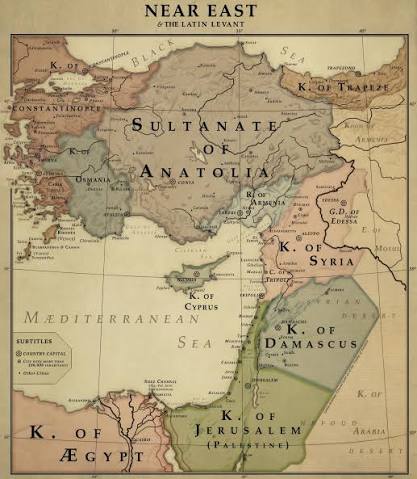
Saladin’s vision of capturing Jerusalem did not materialize overnight. Over the years, he consolidated his power by taking strategic centers like Aleppo, Damascus, Mosul, and Diyarbakır one by one, gradually tightening the noose around the Crusader kingdoms. Interestingly, during his military marches, Saladin would pass right in front of Crusader castles, practically challenging them, yet the Crusader army would not step outside their walls. The Knights Templar and the Kingdom of Jerusalem were aware of this powerful new player on the field, but “the snake would not come out of its hole.”
That is, until an arrogant Crusader commander named Raynald of Châtillon plundered a Muslim caravan and broke the truce. Saladin diplomatically demanded the return of the goods. When this demand was rejected, the legitimate ground for war was set. As Saladin’s army marched out, the Crusaders still believed they would fight on their own terms and destroy the Ayyubid army by exhausting it.
Tactical Collapse: Water, Geography, and Fire
July 1187. The hottest days in the geography of Palestine. The Crusader army, with a force of approximately 23,000 men (including special, heavily armored units tied to the Templars), marched out to confront Saladin’s army of nearly 30,000. The Crusaders’ plan was simple: swiftly seize the water sources in the Galilee region and leave the Ayyubid army stranded without water in the middle of the desert. According to their calculations, they would reach these sources with a 4-5 hour march.
However, war does not conform to plans on paper. “A destiny above destiny” and Saladin’s genius came into play here.
Saladin knew the Crusaders would head for the water sources. Instead of retreating or engaging in a direct pitched battle, he positioned his archer units on strategic hills. The moment the Crusader army began its march, the Ayyubid archers launched a continuous “hit-and-run” tactic, raining down arrows without ever leaving their range.
This relentless rain of arrows dramatically reduced the marching speed of the Crusader army. As the armored knights tried to protect themselves, their formation broke down. Hours passed, and the water sources meant to be reached in 4 hours were still nowhere in sight. Under the July heat, the Crusader army, clad in heavy armor, slowly began to perish from thirst.
Psychological Collapse and Annihilation
As the sun set, the Crusader army had still not reached water. They were forced to take refuge on a hill overlooking the Sea of Galilee (the Horns of Hattin). However, the slopes between them and the lake had already been occupied by Ayyubid soldiers. Water was just a kilometer below them, but reaching it was impossible.
For the Crusader army, which spent the night exhausted and parched, the real nightmare began in the morning. Troops under the command of Saladin’s brother, Gökböri, set fire to the dry grass surrounding the hill where the Crusaders were stationed. Already depleted by thirst and heat, the Crusader army was now trapped in the midst of dense smoke and flames. Even breathing turned into torture. You couldn’t see your hand in front of your face.
In this chaotic environment, Ayyubid cavalry emerged from the smoke and launched shock assaults. The Crusader army’s formation completely collapsed. Those trying to flee, those choking from the smoke, and those put to the sword… The battle had ceased to be a pitched engagement and had turned into an execution. Even the True Cross, which the Crusaders had brought to the battle as a motivation and believed to be the cross Jesus was crucified on, fell into the hands of the Ayyubids.
Justice in the Tent
When the battle ended, the Crusader army was annihilated. Saladin had the captive King of Jerusalem, Guy, and the caravan raider who caused the war, Raynald, brought to his tent. He offered water to the King of Jerusalem, treating him with the respect fit for a king and giving him assurance of his safety. However, he did not show the same mercy to Raynald, who broke the truce and attacked civilians; Saladin personally executed him. The special warriors of the Knights Templar were not spared either.
The Battle of Hattin was not merely a victory that opened the gates of Jerusalem; it was an unprecedented military masterpiece where geography, logistics, and psychology were perfectly blended, drowning the enemy in their own arrogance.